


.png)



The Real Cost of Wholesale Home Storage: MOQ, Pricing Tiers & Hidden Import Costs
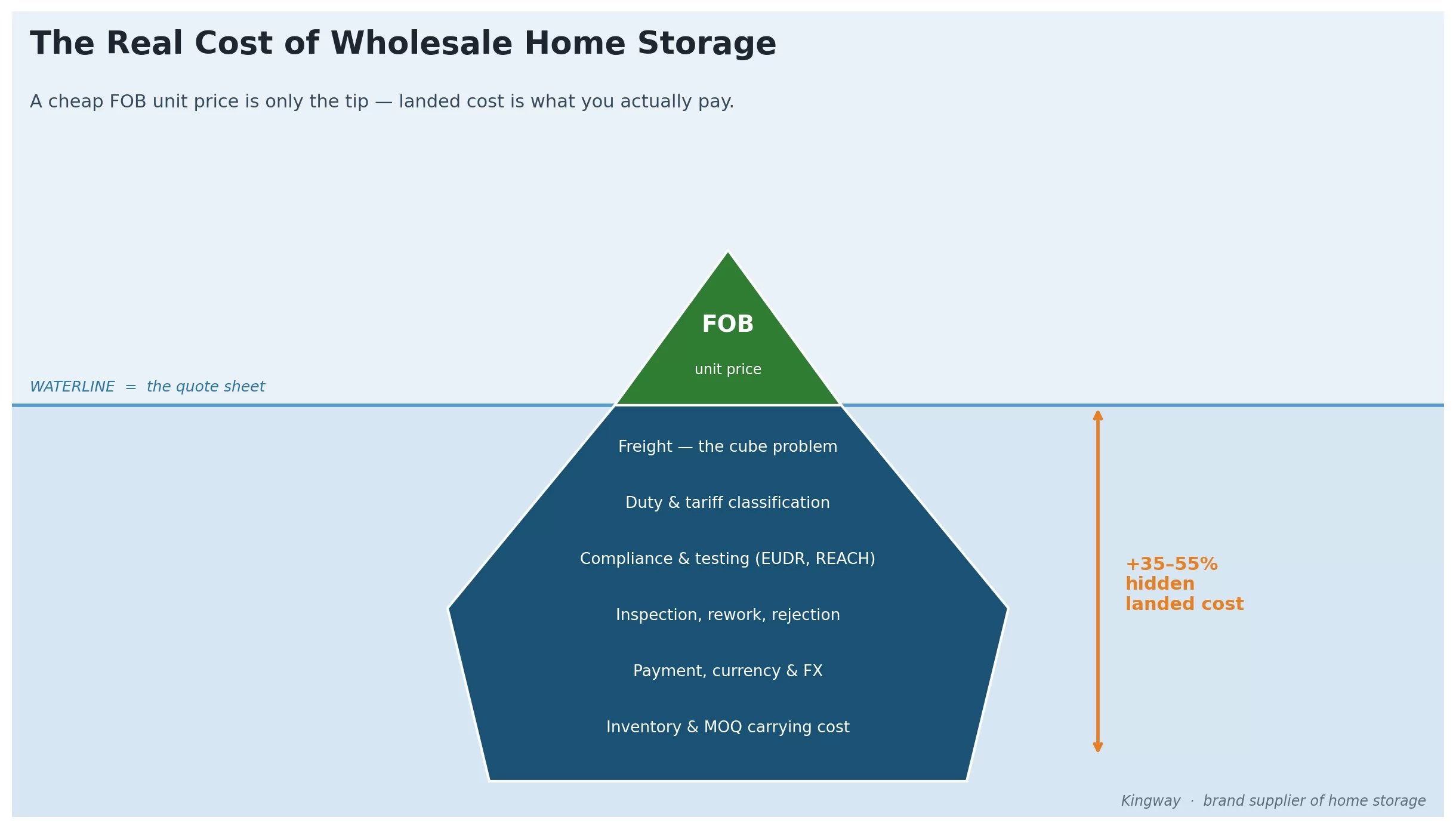
The unit price on a quotation is the number every buyer looks at first, and it is almost never the number that decides whether an order is profitable.
We write this as a brand supplier that quotes these orders every week. The goal is not to defend any particular price — it is to help a retail buyer read a quotation the way the supplier who wrote it does.
1. What a quoted unit price actually contains
A home storage FOB unit price is built from five cost blocks, and the proportion of each one tells you where your negotiation leverage really is.
| Cost block | Share of a typical FOB price | Can the buyer move it? |
|---|---|---|
| Raw material (fabric, bamboo, board, hardware) | 40–55% | Indirectly — via material spec and volume |
| Direct labour | 10–18% | No — fixed by the production region |
| Tooling & setup amortised over the run | 5–20% | Yes — this is why MOQ exists |
| Packaging & labelling | 6–12% | Yes — via carton spec and print complexity |
| Supplier margin & overhead | 8–15% | Partly — via relationship and volume |
The single most important line for understanding MOQ is tooling and setup. A custom size, a custom print carton, a lab-dipped colour, or a new weave all carry a one-time cost that is spread across the units in the run. On a short run that fixed cost dominates the unit price; on a long run it nearly disappears. That is the entire economic logic behind the next section.
2. How MOQ is actually calculated
MOQ is not an arbitrary gate suppliers use to screen small buyers. It is the quantity at which the one-time costs of a run become small enough per unit that the supplier can quote a price the market will accept, while still covering a minimum production-line booking.
Three things set the floor on any home storage MOQ:
- Tooling / setup amortisation. If a custom carton plate costs a fixed amount to produce, splitting it over 1,000 units adds far more to each unit than splitting it over 10,000. Suppliers set MOQ at the point where this per-unit load stops distorting the price.
- Material minimums. Fabric is woven and dyed in rolls; board and bamboo are bought in standardised volumes. A dye-lot or a roll minimum sets a hard floor — ordering below it means paying for material you will not use.
- Line booking minimums. A production line has a minimum economic run length below which the changeover time costs more than the order earns.
For standard catalogue home storage, typical MOQs land around 500–1,000 units per SKU/colour. For custom (OEM/ODM) programmes, the practical floor is usually higher because the tooling and material minimums are larger. The way to lower an MOQ you cannot meet is almost never to simply ask — it is to remove the cost that is driving it: accept a stock colour, use a standard carton, or consolidate several SKUs onto one material base. For how custom programmes differ from catalogue buys, see our OEM vs ODM decision framework.
3. Reading a price tier like the supplier who wrote it
Price tiers are the visible signature of the cost structure in section 1. A typical home storage quote looks like this (illustrative, not a live quote):
| Order quantity (per SKU) | Indexed unit price | What changed |
|---|---|---|
| 500 units | 100 (baseline) | Tooling fully loaded on a short run |
| 1,000 units | 88–92 | Setup cost halved per unit |
| 3,000 units | 78–84 | Material bought at a better bracket |
| 5,000 units | 72–78 | Line booking efficient, setup negligible |
| 10,000+ units | 65–72 | Approaching raw-material-plus-margin floor |
Two things a buyer should take from this:
- The biggest per-unit saving is between the smallest two tiers, because that is where the fixed setup cost is being spread. The saving from 5,000 to 10,000 units is real but much flatter — you are already near the material floor.
- A price that keeps dropping steeply at high volume is a warning sign, not a win. It usually means the baseline quote was padded, or that a material downgrade is hiding in the larger tier. Ask what changed between tiers; a transparent supplier can tell you.
4. The hidden costs that turn a cheap unit price into an expensive landed cost
This is where orders are won and lost. The following costs are real, routine, and usually absent from the first quote comparison. We have listed them in the rough order of how often they surprise a first-time buyer.
4.1 Freight and the cube problem
Home storage is bulky and light — it “cubes out” a container before it hits the weight limit. Two boxes at the same unit price can have very different freight costs per unit if one nests or flat-packs and the other ships rigid. Always compare freight per sellable unit, not per kilo. A nesting design can cut the per-unit ocean cost substantially on the same lane.
4.2 Duty and tariff classification
The HS code assigned to the product sets the duty rate, and small spec differences (material composition, whether an item is “textile” vs “plastic” vs “wood”) can move a product between duty brackets. Confirm the classification before the order, not at customs.
4.3 Compliance and documentation
EU-bound home storage carries compliance obligations that cost real money to meet — testing, documentation, and traceability. EUDR for wood/bamboo-content products and packaging rules both add cost that a non-compliant quote simply omits. A quote that is cheap because it skips compliance is not cheap; it is a deferred customs risk. See our EUDR 5-point checklist and the EU packaging & labelling map.
4.4 Quality cost — inspection, rework, and rejection
A missed defect found at destination is the most expensive unit cost of all. Budget for inspection, and treat it as insurance, not overhead. The economics of this are covered in our 7-point pre-shipment inspection guide.
4.5 Payment, currency, and finance cost
Deposit terms, the gap between deposit and balance, and the FX rate between quote and payment all move the real cost. On a long lead time, currency drift alone can erase a tier saving.
4.6 Inventory and MOQ carrying cost
Buying a bigger tier to hit a lower unit price only pays if the stock sells before its carrying cost (warehousing, capital, obsolescence) eats the saving. A lower unit price on 10,000 units you sell over three years is often more expensive than a higher price on 3,000 units you turn in one season.
5. Landed cost: the only number that matters
The way to compare two suppliers fairly is to build a landed cost per sellable unit, not to compare FOB prices. The formula every buyer should run before signing:
Landed cost per unit = (FOB unit price) + (freight ÷ units) + (duty) + (compliance & testing ÷ units) + (inspection ÷ units) + (finance & FX cost) + (inbound logistics ÷ units)
Run this for each supplier and each tier. The cheapest FOB quote frequently loses once freight-per-unit and compliance are loaded in — particularly when the cheap quote is a rigid design that cubes out, or omits testing. For a worked example of how a retailer rebuilt their sourcing around landed cost rather than unit price, see our 30% cost-reduction case study.
6. Five levers to lower cost without lowering quality
- Consolidate SKUs onto one material base so a single dye-lot or roll serves several products — spreads material minimums.
- Accept stock colours and standard cartons where the shelf doesn’t need a custom one — removes tooling cost that drives MOQ.
- Choose nesting or flat-pack designs to cut freight per unit — often the single biggest hidden saving.
- Order to your sell-through, not to the price tier — avoid buying a cheaper unit you carry for years.
- Lock compliance at the PO stage so testing and documentation are priced in, never discovered at the border.
7. Frequently Asked Questions
How is MOQ calculated for home storage products?
MOQ is set by three floors: the point at which one-time tooling/setup cost per unit becomes acceptable, the material purchase minimum (dye-lots, board or bamboo volumes), and the minimum economic production-line run. For standard catalogue items, typical MOQs are around 500–1,000 units per SKU/colour; custom programmes are usually higher.
Why does the unit price drop so much between the first two tiers?
Because the fixed setup and tooling cost is being spread over more units. The biggest per-unit saving is almost always between the two smallest tiers; above the mid-tiers you approach the raw-material-plus-margin floor and the curve flattens.
What is the difference between FOB price and landed cost?
FOB price is the cost of the goods at the port of origin. Landed cost adds freight, duty, compliance and testing, inspection, finance/FX, and inbound logistics — the all-in cost per sellable unit at your warehouse. Landed cost is the only number that lets you compare two suppliers fairly.
Which hidden cost surprises first-time buyers most?
Freight, because home storage cubes out a container before it reaches the weight limit. A rigid design can cost far more per unit to ship than a nesting one at the same FOB price.
Can I negotiate a lower MOQ?
Usually only by removing the cost that drives it — accepting a stock colour, a standard carton, or consolidating SKUs onto one material base. Asking for a lower MOQ without changing the cost structure rarely works, because the floor is set by real material and setup minimums.
8. Talk to Kingway about your next home storage order
If you are comparing quotes for a Q4 or 2027 home storage programme, we are happy to build a transparent tier-and-landed-cost breakdown for your specific SKUs rather than a single FOB number. As a brand supplier managing design, sourcing, compliance, and QC end to end, we can show where each cost sits and which lever actually moves it for your assortment. Request the quote and ask for the tier breakdown — it is the document that makes the real cost visible.